My Teaching Statement
Since I completed my PhD, I have developed a teaching and supervision profile centred on data management, with a strong emphasis on fundamentals, deliberate practice, and structured student autonomy. My goal as an educator is to train students to be accurate judges of their own abilities and effective, independent problem solvers who can easily adapt to future technologies.
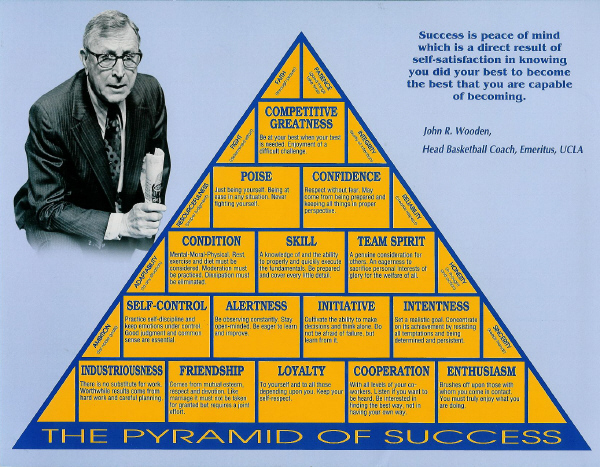
My teaching is guided by three principles adapted from John Wooden’s “Pyramid of Success”: industriousness, enthusiasm, and skill. Industriousness means that sustained work on fundamentals matters more than single high-stakes exams. I design courses as progressively demanding paths, with regular checkpoints and feedback, so that students build competence through deliberate practice rather than through last-minute effort. Enthusiasm is my responsibility as an instructor; I structure challenging but meaningful tasks and model the energy needed to navigate inevitable frustration, especially when students work outside their comfort zone. Skill, i.e., the ability to act quickly and correctly, drives my emphasis on mastering technical content (data models, query languages, algorithms, systems) and “soft” skills (writing, presenting).
I treat courses as a learning path rather than a sequence of evaluation points. In the early stages of a course, I emphasize core concepts and structured exercises; in later stages, I give students more autonomy to make choices, justify them, and, whenever possible, explore the subject outside the course boundaries. Assessment is designed to reward both mastery of fundamentals and the ability to generalize these fundamentals to new technologies and contexts. The aim is that, years after the course, students recall the principles behind the technologies they use, can articulate design decisions, and can learn new tools independently.
I have systematically drawn on teaching books, online resources, and formal training opportunities. I completed a leadership course at the University of Tartu, a Massive Open Online University Teaching during my first year at INSA Lyon, and a three-day seminar associated with my associate professor qualification. These experiences have informed how I think about leadership in the classroom, course design, and supervision. I have also learned by co-teaching with experienced colleagues such as Emanuele Della Valle, Matteo Pradella, Marco Colombetti, and Sherif Sakr, from whom I have gained practical strategies for organizing a class, structuring assignments, and maintaining a positive, respectful environment.
Teaching experience and breadth
I began teaching in 2012 as a software engineering lab tutor at Politecnico di Milano. During my PhD (2015–2019) I was a teaching assistant and occasional lecturer on courses in Big Data, Data Management, Programming Languages, and Knowledge Engineering, typically with cohorts of 60–150 students. As an Assistant Professor at the University of Tartu (2019–2021 full time; 2022–present part-time) I designed a new course, “Foundations of Data Engineering”, which has run there every year since 2019. Since 2021 I have also taught this course at INSA Lyon as part of the Computer Science curriculum and the international MINDS master programme.
Since 2021, I have been teaching courses in data management, including relational, graph and NoSQL databases, data warehousing, data engineering, and streaming data engineering. At Politecnico di Milano, I have also taught modules on the Semantic Web Technologies (RDF, OWL, SHACL) and knowledge representation. In addition, I am comfortable teaching all basic computer science courses, e.g., for undergraduate teaching in databases, algorithms and data structures, programming, and systems, and for graduate-level courses in data engineering, data warehousing, stream processing, and semantic web technologies.
Incorporating “soft skills” into technical courses is a key aspect of my teaching approach. Since 2022, I have been instructing a public speaking module at Claude Bernard Lyon 1 University. This year, I introduced a research methods course on data system research at INSA Lyon. Additionally, I frequently integrate modules on technical writing into project-based courses, requiring students to compose concise technical reports.
I over the years, I obtained consistently positive student evaluations and detailed qualitative feedback. The course “Foundations of Data Engineering” has seen marked improvements in student evaluations over the years. Recent comments highlight the course’s impact on students’ motivation and career plans; for example, one student noted that it “gave me motivation back for studies in general” and “will enhance my professional career after university”.
On my website, I maintain an anonymous feedback form. This continuous feedback has been valuable in refining aspects such as my pacing, clarity of explanations, and the organization of practical sessions. For example, based on student suggestions, I introduced a dedicated session on Docker and tooling.
Mentoring and supervision
Mentoring is one of the most rewarding aspects of academic life. I see it as a privilege to influence students’ careers and intellectual development, and I approach it with the same values that shape my teaching, with the addition of Wooden’s “competitive greatness”: calibrating difficulty so that students are most engaged when their best effort is required.
Since 2020, I have supervised three PhD students who have successfully defended their theses. Mohamed Ragab (2021, I was the main supervisor, co-supervised with Ahmed Awad) is now a lecturer at the University of Birmingham; Kristo Raun (2022, co-supervised with Ahmed Awad) is a lecturer at the University of Tartu; and Samuele Langhi (2024, I was the main supervisor, co-supervised with Prof. Angela Bonifati) is a software engineer at Ververica, a leading European company in stream processing. I currently supervise two PhD students, Mauro Fama (I am the main supervisor, co-supervised with Prof. Angela Bonifati) and Gianluca Rossi (co-supervised with Prof. Angela Bonifati), and act as co-supervisor for additional students at other universities. Moreover, I maintain a mentoring relationship with some students outside France: Alessandro Ferri (TU Darmstadt, supervised by Prof. Carsten Binning) and Mouna Ammar (Leipzig University, supervised by Prof. Erhard Rahm). For both, I am involved in their PhD program as a collaborator.
When I supervise a master’s or PhD project, I invest substantial time in problem formulation. I use a “Macro–Meso–Micro” breakdown, where the student and I jointly articulate the high-level motivation and research question (Macro), the main design choices and trade-offs (Meso), and the concrete technical questions, experiments, and evaluation criteria (Micro). This structure helps students move between abstraction levels, avoid both vagueness and premature technical detail, and converge on research plans that are both ambitious and feasible. Since my PhD, I supervised 18 master and bachelor students. The work of several of them resulted in international-level publications such as ESWC, ISWC, and VLDB; three received additional academic recognition for research results achieved during their master’s thesis.
Communication, collegiality, and inclusive practice
I place particular emphasis on clear, respectful communication and on contributing to a supportive and inclusive working environment. In my current role as Associate Professor, I supervise a diverse group of MSc and PhD students through structured one-to-one meetings and written follow-up notes that clarify expectations, decisions, and next steps. In the classroom, I combine enthusiasm with transparency about workload and assessment, and I aim to build an empathetic relationship with students while maintaining clear boundaries and control of the group.
I am attentive to interpersonal dynamics in group work and have, on several occasions, acted as a mediator when conflicts emerged. In one case, a group of students in Estonia attempted to exclude a colleague from their project. Together with my colleague Kristo Raun, I facilitated a resolution by clarifying expectations, revisiting assessment criteria, and ensuring that all students could contribute meaningfully. The group ultimately completed the course successfully. I view such interventions as integral to maintaining a fair, respectful environment rather than as ancillary to teaching.
Future teaching
My teaching and research fall within the Data Management and Data Systems areas, with strong connections to AI and knowledge representation through stream and graph processing, logic programming, and semantic web technologies. At undergraduate level I can contribute immediately to basic computer science courses, e.g. databases, data structures and algorithms, programming, and software engineering, as well as more specialised courses in data warehousing and data engineering. At graduate level I can offer advanced modules on data systems, streaming and graph data processing, and semantic web technologies, building a coherent path from foundational data modelling to modern large-scale data systems.
References
Enjoy Reading This Article?
Here are some more articles you might like to read next: